
Heat & Cooling Rules for Chicago-Area Rentals and Condos (2026)
Updated October 2026
Part of our Chicagoland Local Data series.
Chicago building inspectors cited landlords for inadequate heat 390 times in the 2025-26 heat season, and January is by far the worst month for these citations [6]. This page sets out the heat and cooling rules that apply to apartments and condos in Chicago and nearby suburbs: the temperatures, the dates, the tenant remedies, the condo board’s duties and the utility shut-off limits, each linked to the code or dataset it comes from.
This is general information, not legal advice. Tenants with a heat problem can call 311 in Chicago, their village hall in the suburbs, or a legal aid office.
Key Takeaways
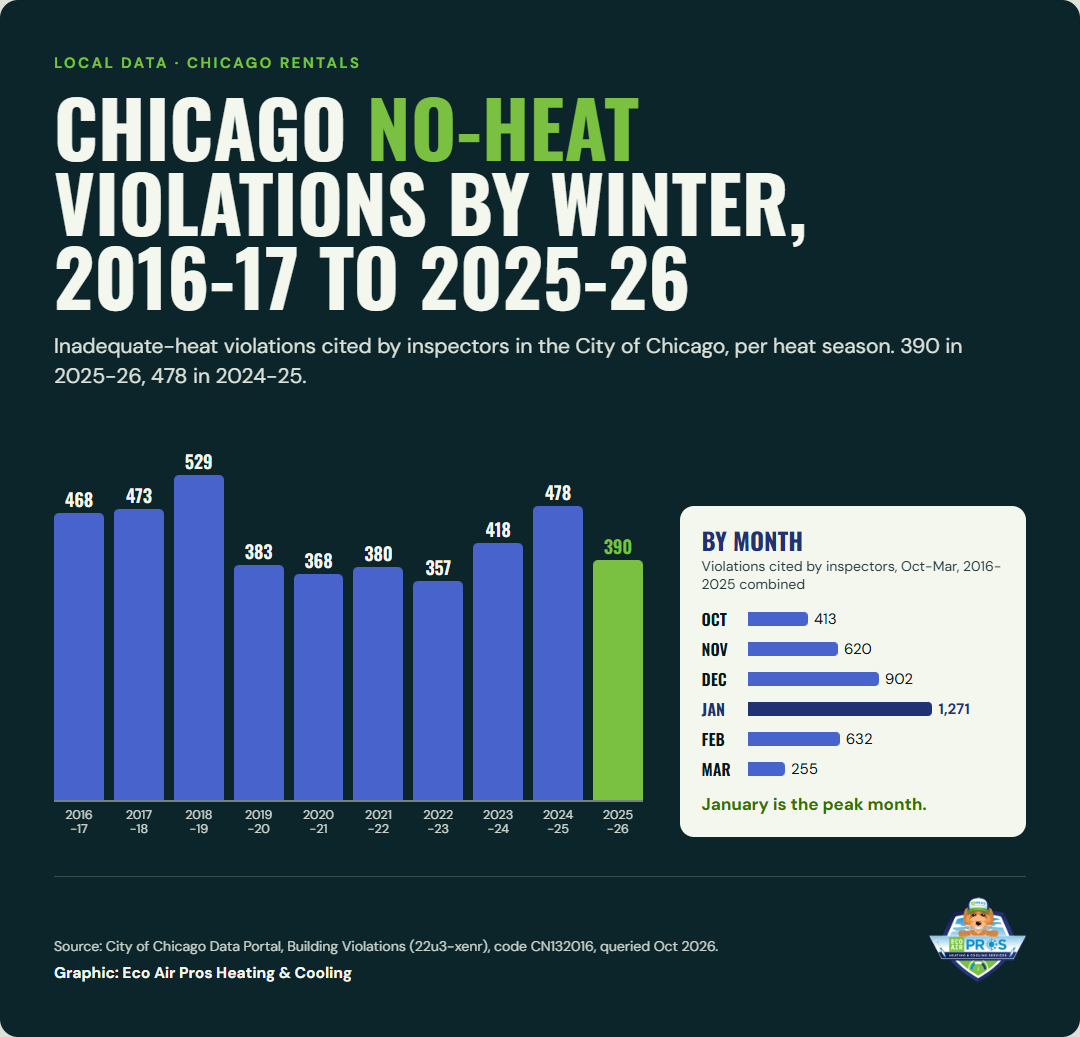
- Over the last ten heat seasons, Chicago’s yearly count of inadequate-heat violations ranged from 357 (2022-23) to 529 (2018-19). [6]
- January produced 1,271 of the 4,328 Chicago heat violations cited from 2016 through 2025, about 29%. [6]
- The worst single January of the past decade was 2024, with 228 heat violations cited. [6]
- Chicago fines landlords $500 to $1,000 per day for failing to provide heat, and the reason for the failure does not matter. [3]
- The suburban heat season starts on different dates: Sept 1 in Mount Prospect, Sept 15 in Chicago and Elmwood Park, Oct 1 in Elk Grove Village. [14][15]
- In suburban Cook County, a tenant can withhold rent or buy heat if it is not restored within 24 hours of written notice, and can end the lease after 72 hours. [8]
- Elmwood Park sets its own 36-hour clock before tenants can buy heat and deduct the cost. [11]
- Illinois utilities cannot cut off heating service for nonpayment on a day forecast at 32°F or below, or cooling service on a day forecast at 90°F or above. [21]
- Since 2022, Chicago apartment buildings with more than 100 units or high-rise height must have permanent air conditioning in at least one common room. [2]
- Chicago residents filed 516 non-duplicate 311 “No Air Conditioning” requests in 2025, the highest full year since the request type began in 2022. [27]
- During the January 2026 cold snap, Chicago listed 284 public facilities available for warming. [24]
- The city’s cooling-center list has 287 sites, 110 of them Park District spray features. [25]

What temperature must a Chicago landlord keep the apartment?
From September 15 to June 1, a Chicago building with a shared heating plant must keep every apartment at 68°F or warmer from 8:30 a.m. to 10:30 p.m., and at 66°F or warmer overnight [1]. That applies in every habitable room, bathroom and toilet room, with windows and outside doors closed.
Other parts of the same chapter of the Municipal Code fill in the details [1]:
- Every unit needs permanent heating equipment that can hold 68°F when it is -7°F outdoors. Space heaters, stoves and water heaters do not count toward that capacity.
- Temperature is measured 3 feet above the floor and at least 3 feet from any outside wall.
- A landlord can make the tenant pay for the gas or electricity, but must still provide working heating equipment.
- Buildings that heat and cool through the same pipes (two-pipe systems) get a lower 64°F floor in two shoulder windows: September 15 to October 31 until the first night below 45°F, and April 1 to June 1 from the first day above 75°F. These dates come from a May 20, 2026 amendment.
- Since a June 17, 2026 amendment, heating and cooling equipment must be kept in proper operating condition, and the city can ask for a condition report.
The Department of Buildings treats a breakdown during heat season as an immediate violation, sets the fine per day, and says fireplaces cannot be used to meet the rule. It advises owners to inspect heating equipment in late summer [3]. One caution for anyone quoting the city’s own heat web page: it refers to the heat rule as section 14X-8-803 and shows older two-pipe dates. In the current code, 802 is heat and 803 is cooling, so cite the code text [1].
Do Chicago landlords have to provide air conditioning?
Only some buildings do. Since the 2022 cooling ordinance, senior housing must have permanent cooling in all indoor common gathering spaces, and large or high-rise apartment buildings must cool at least one such space [2].
The equipment has to hold 75°F and 50% relative humidity on a 92°F design day. Portable units were accepted only until May 1, 2024; after that the cooling had to be permanent. Nursing homes have a stricter standard covering all rooms and corridors [2].
Two parts of the rule matter most for older boiler buildings. First, the cooling must run on any day the heat index tops 80°F. Second, it must either be independent of the heating system or able to switch from heat to cool within one hour [2]. When apartments do not each have AC, an air-conditioned room must be open to every resident. The Mayor’s Office announced the rule on June 22, 2022, describing the covered buildings as taller than 80 feet or with over 100 dwelling units [4]. In July 2026 the city’s emergency management office again told owners to check their cooling equipment before the heat arrives [5].
The city’s 311 data shows the demand side. “No Air Conditioning” requests first appeared in June 2022, and 2026 had already reached 514 non-duplicate requests by October 29 [27].
How often does Chicago cite landlords for no heat?
Every winter, by the hundreds. The 2025-26 count was down from 478 in 2024-25, but no season in the past decade has dropped below the mid-300s [6].
Embed this graphic
Free to use on your site, newsletter or story. Copy the code below; please keep the credit link.
Inadequate-heat violations cited by Chicago building inspectors in each heat season (July to June), with the decade’s monthly pattern. Source: City of Chicago Data Portal, Building Violations, code CN132016, queried Oct 29, 2026.
These figures count violations cited by inspectors under the city’s heat code (violation code CN132016, “Heat unit adequately”). They are not a count of calls from tenants: the city’s public 311 data has no separate “no heat” request type, so those calls cannot be counted on their own. Last season’s citations came from 389 separate inspections [7].
The pattern by month is steady. Citations build from 413 in October to 620 in November and 902 in December, then fall to 632 in February and 255 in March (2016-2025 combined) [6]. Nearly every citation follows an inspection that someone requested, not a routine periodic visit; in the 2025-26 season, all of them did [7]. In practice that means a no-heat citation usually starts with a resident picking up the phone in the coldest weeks of the year.
The 2026-27 season is just starting. The most recent record, dated October 23, 2026, shows an inspector reading 65°F and 66°F in a South Side apartment with the heating system off [7].
When does the heat season start in Chicago's suburbs?
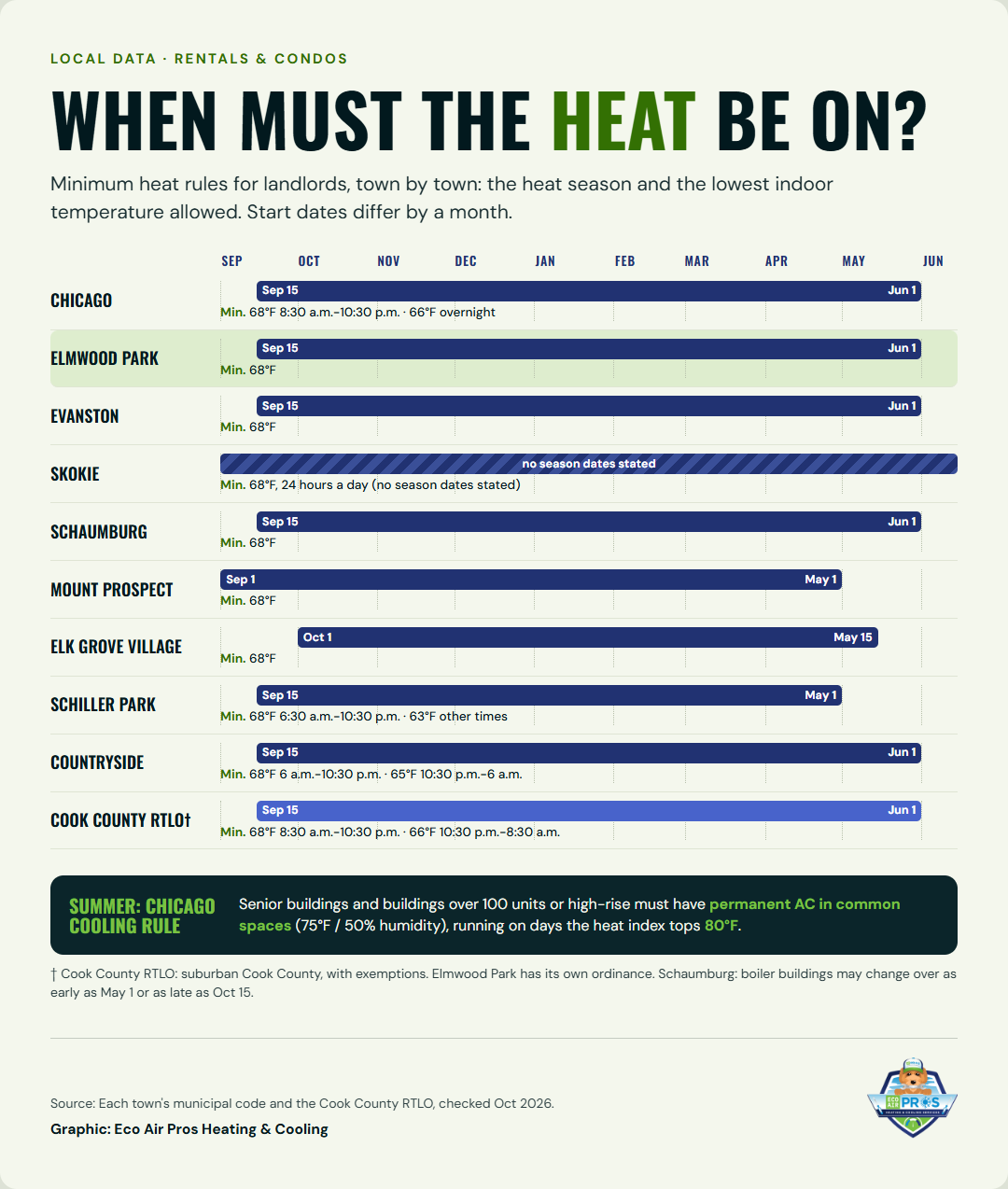
It depends on the town. Most suburbs use the International Property Maintenance Code, which requires 68°F in habitable rooms but leaves the season dates blank for each village to fill in [17]. The result is a start date that varies by a month across the area.
Embed this graphic
Free to use on your site, newsletter or story. Copy the code below; please keep the credit link.
The months each town requires landlords who supply heat to keep units warm, with day and night minimums. Sources: each town’s municipal code and the Cook County RTLO, checked Oct 29, 2026.
| Town | Heat season | Day minimum | Night minimum | Source |
|---|---|---|---|---|
| Chicago | Sept 15 to June 1 | 68°F (8:30 a.m. to 10:30 p.m.) | 66°F | [1] |
| Suburban Cook County (RTLO) | Sept 15 to June 1 | 68°F (8:30 a.m. to 10:30 p.m.) | 66°F | [8] |
| Elmwood Park | After Sept 15 through June 1 | 68°F | 68°F (no separate night figure) | [10] |
| Evanston | Sept 15 to June 1 | 68°F | 68°F (no separate night figure) | [12] |
| Skokie | No dates stated | 68°F, 24 hours a day | 68°F | [13] |
| Schaumburg | Sept 15 to June 1 | 68°F | 68°F (no separate night figure) | [16] |
| Countryside | Sept 15 to June 1 | 68°F (6 a.m. to 10:30 p.m.) | 65°F | [18] |
| Schiller Park | Sept 15 to May 1 | 68°F (6:30 a.m. to 10:30 p.m.) | 63°F | [19] |
| Mount Prospect | Sept 1 to May 1 | 68°F | 68°F (no separate night figure) | [14] |
| Elk Grove Village | Oct 1 to May 15 | 68°F | 68°F (no separate night figure) | [15] |
A few notes on the table. Elk Grove Village has moved to the 2024 edition of the model code [15]. Schaumburg lets boiler buildings switch between heating and cooling as early as May 1 or as late as October 15 [16]; a 2021 village staff memo found boiler systems in 16 of 30 multifamily complexes surveyed and said a changeover can take eight hours and two maintenance workers [26]. Countryside’s day and night minimums apply when it is -20°F or warmer outside [18]. Skokie’s figure comes from a village inspection handout rather than the code text [13]. Elmwood Park fines code violations $50 to $750, and each day counts as a separate offense [10]. Towns not listed were left out because we could not confirm their current dates from the code itself.
What can a tenant do when the heat goes out?
Give the landlord written notice, then the clock starts. How long the landlord has, and what the tenant may do next, depends on where the building is.
- Chicago (RLTO): after written notice, a tenant may withhold a fair part of the rent if heat is not restored within 24 hours, and may end the lease if the failure lasts more than 72 hours. Neither applies when the utility company caused the outage [20]. The RLTO does not cover owner-occupied buildings with six or fewer units [22].
- Suburban Cook County (RTLO): the same 68°F and 66°F standard as Chicago is written into the ordinance itself, with the remedies listed in the takeaways above [8]. In effect since June 1, 2021, it exempts owner-occupied buildings with six or fewer units and some single rented homes or condos, bars landlords from cutting off heat to force a tenant out, and is enforced through private action, not by a county inspector [9].
- Elmwood Park (Chapter 41B): the village’s own ordinance replaces the county RTLO. The tenant may ask for heat to be restored or for substitute housing nearby at the landlord’s cost. Once the village’s deadline passes, the tenant may buy heat and deduct it from rent, or recover damages. These remedies do not apply to buildings with six or fewer units [11].
Other home-rule suburbs may have their own versions, so check the village code before assuming the county rule applies. For help, Chicago tenants can call 311 and suburban tenants can call their village’s code enforcement office or a legal aid group.
Who is responsible for the boiler in a condo building?
The condo board. Under the Illinois Condominium Property Act, the board must provide for the “operation, care, upkeep, maintenance, replacement and improvement of the common elements,” which includes a shared boiler, chiller or rooftop unit [23].
Two details in the same section matter when a central plant fails. Spending caps in the condo’s declaration or bylaws do not apply to repairing or replacing mechanical components or energy systems and equipment with their functional equivalent. And board members owe unit owners “the care required of a fiduciary” [23]. The Act does not set an indoor temperature. A condo unit that is rented out follows the same heat rules as any other rental: the Chicago code or the suburban property maintenance code, and the RTLO unless one of its exemptions applies [9].
Buildings with three or more units may also qualify for a joint utility program covering boiler projects; see our rebates hub. Replacing central equipment may need a permit, which our permits hub covers town by town.
Can the utility shut off heat or AC in extreme weather?
Not on the coldest or hottest days. Illinois law bars gas and electric utilities from disconnecting residential customers for nonpayment, including every tenant of a master-metered apartment building, on days with the temperature forecasts listed in the takeaways above. The cooling protection also applies whenever the National Weather Service issues an excessive heat watch, heat advisory or excessive heat warning [21].
Two state rules add winter protection. From December 1 through March 31, a utility cannot disconnect a heating customer or a master-metered building for nonpayment unless it has offered a deferred payment plan of at least four months with a down payment of no more than 10 percent of the past-due amount [28]. An older Illinois Commerce Commission rule still lists a higher hot-weather threshold for large electric utilities [29], but the statute’s lower trigger is the current law and controls.
Where can residents go when a building's heat or AC fails?
In Chicago, to a city warming or cooling center. The Family and Support Services department opens warming areas at its community service centers and senior centers at 32°F or below [24], and opens cooling areas at its six community service centers at 90°F and above, weekdays 9 a.m. to 5 p.m. [5].
The January 2026 network included 148 parks, 80 libraries, 22 police districts and 21 senior centers [24]. The cooling list adds 79 libraries, 43 Park District facilities and 20 senior centers among other sites [25]. Call 311 for current hours before going.
The National Weather Service office in Chicago sets the alerts that trigger these responses. A Heat Advisory goes out areawide for one day with a peak heat index of 105°F or higher [30]. In winter, a Cold Weather Advisory is issued for a wind chill or temperature of -20°F or colder, and an Extreme Cold Warning when -30°F or colder is expected [31].
How we put this together
Every rule on this page comes from the current published text of a municipal code, the Cook County code, an Illinois statute or administrative rule, or an official city or National Weather Service page. Violation counts come from the City of Chicago Data Portal’s Building Violations dataset, queried on October 29, 2026 for violation code CN132016 and grouped by heat season (July through June) and by month. The 311 “No Air Conditioning” counts exclude requests the city marks as duplicates. Online code libraries can lag behind newly passed ordinances, so confirm with the city or village before acting. We plan to refresh the data after each heat season.
Glossary
- RLTO: Chicago Residential Landlord and Tenant Ordinance (Municipal Code Chapter 5-12).
- RTLO: Cook County Residential Tenant and Landlord Ordinance, covering suburban Cook County where a town has not replaced it.
- IPMC: International Property Maintenance Code, the model code most suburbs adopt for existing buildings.
- DOB: Chicago Department of Buildings.
- Two-pipe system: a central system that uses the same pipes for heating and cooling, so it can only do one at a time.
- Master-metered building: an apartment building where one utility meter serves several units.
Back to the Chicagoland Local Data series, or see the HVAC rebates hub and the furnace and AC permits hub.
Sources
- City of Chicago (American Legal Publishing), Municipal Code Chapter 14X-8, Section 14X-8-802 Heating Systems. codelibrary.amlegal.com. Checked Oct 29, 2026.
- City of Chicago (American Legal Publishing), Municipal Code Section 14X-8-803 Cooling and Dehumidification Equipment. codelibrary.amlegal.com. Checked Oct 29, 2026.
- Chicago Department of Buildings, Chicago Heat Ordinance. chicago.gov. Checked Oct 29, 2026.
- City of Chicago Mayor’s Office, City of Chicago Announces Update to Heating and Cooling Ordinance (June 22, 2022). chicago.gov. Checked Oct 29, 2026.
- Chicago Office of Emergency Management and Communications, The City of Chicago Urges Residents to Prepare for Extreme Heat (July 13, 2026). chicago.gov. Checked Oct 29, 2026.
- City of Chicago Data Portal, Building Violations (22u3-xenr), code CN132016 by year and month. data.cityofchicago.org. Checked Oct 29, 2026.
- City of Chicago Data Portal, Building Violations (22u3-xenr), code CN132016 by inspection and inspection category, 2025-26 season and latest record. data.cityofchicago.org. Checked Oct 29, 2026.
- Cook County, Residential Tenant and Landlord Ordinance, Code Section 42-805 (Ord. 20-3562), posted June 2026. cookcountyil.gov (PDF). Checked Oct 29, 2026.
- Cook County Commission on Human Rights, Residential Tenant Landlord Ordinance overview. cookcountyil.gov. Checked Oct 29, 2026.
- Village of Elmwood Park, Village Code Chapter 10 Article I, Section 10-2A Adoption of Property Maintenance Code. ecode360.com. Checked Oct 29, 2026.
- Village of Elmwood Park, Village Code Chapter 41B Rental Residential Property (Ord. 2021-45). ecode360.com. Checked Oct 29, 2026.
- City of Evanston, Heat Requirements. cityofevanston.org. Checked Oct 29, 2026.
- Village of Skokie, Property Maintenance Inspection Process and Code Information (rental inspection handout). skokie.org. Checked Oct 29, 2026.
- Village of Mount Prospect (American Legal Publishing), Village Code Section 21.603 Property Maintenance Code amendments (Ord. 6607). codelibrary.amlegal.com. Checked Oct 29, 2026.
- Village of Elk Grove Village (American Legal Publishing), Village Code Section 8-3H-1 Property Maintenance Code Adopted. codelibrary.amlegal.com. Checked Oct 29, 2026.
- Village of Schaumburg (Municode), Code of Ordinances Section 99.02 (Am. Ord. 26-005). library.municode.com. Checked Oct 29, 2026.
- International Code Council, 2021 International Property Maintenance Code, Chapter 6, Section 602.3 Heat Supply. codes.iccsafe.org. Checked Oct 29, 2026.
- City of Countryside (American Legal Publishing), City Code Section 8-14-5-3 Rental Housing Standards. codelibrary.amlegal.com. Checked Oct 29, 2026.
- Village of Schiller Park (American Legal Publishing), Code Section 98.20 Minimum Standards for Heat. codelibrary.amlegal.com. Checked Oct 29, 2026.
- City of Chicago (American Legal Publishing), Municipal Code Section 5-12-110 Tenant Remedies. codelibrary.amlegal.com. Checked Oct 29, 2026.
- Illinois General Assembly, 220 ILCS 5/8-205 (Public Utilities Act, termination of service in extreme weather). ilga.gov. Checked Oct 29, 2026.
- City of Chicago (American Legal Publishing), Municipal Code Sections 5-12-020 and 5-12-070. codelibrary.amlegal.com. Checked Oct 29, 2026.
- Illinois General Assembly, 765 ILCS 605/18.4 (Condominium Property Act, powers and duties of the board). ilga.gov. Checked Oct 29, 2026.
- City of Chicago Mayor’s Office, Extreme Cold PSA (January 22, 2026). chicago.gov. Checked Oct 29, 2026.
- City of Chicago Data Portal, Cooling Centers (msrk-w9ih), sites by type. data.cityofchicago.org. Checked Oct 29, 2026.
- Village of Schaumburg Community Development, Provision of Heat/Air-Conditioning in Apartment Buildings with Centralized Units (staff memo, June 18, 2021). schaumburg.novusagenda.com (PDF). Checked Oct 29, 2026.
- City of Chicago Data Portal, 311 Service Requests (v6vf-nfxy), “No Air Conditioning” (NAC) non-duplicate requests by year. data.cityofchicago.org. Checked Oct 29, 2026.
- Illinois Commerce Commission, 83 Ill. Adm. Code 280.135 (winter termination protections). ilga.gov. Checked Oct 29, 2026.
- Illinois Commerce Commission, 83 Ill. Adm. Code 280.130 (disconnection of service). ilga.gov. Checked Oct 29, 2026.
- National Weather Service Chicago, Heat Safety and Preparedness. weather.gov. Checked Oct 29, 2026.
- National Weather Service Chicago, Winter Weather Preparedness. weather.gov. Checked Oct 29, 2026.
Get in Touch with Eco Air Pros Today
Ready to enhance your comfort? Contact Eco Air Pros Heating and Cooling your top tier HVAC Contractor at (312) 465-8060 or email help@ecoairpros.net for expert HVAC solutions tailored to your needs.
(312) 465-8060